
Mississippi DOC Release Paths
MDOC administers state prison sentences. Its records can follow a sentenced person from admission through an institution, a regional correctional facility, community supervision, and final discharge. That statewide trail is the right one for an MDOC prisoner who was housed in Cleveland or convicted in Bolivar County. It is not a substitute for the county booking record of each person held at the Bolivar County Correctional Facility. A local pretrial detainee may never receive an MDOC number.
Leaving an MDOC institution can mean release on parole, earned-release supervision, or expiration of the sentence. Parole is release authorized by the Mississippi State Parole Board while part of the prison term remains. Earned-release supervision, often called ERS, is an MDOC status under earned-time law. A person on ERS remains under MDOC jurisdiction. Discharge means the relevant state sentence and any related custody authority have ended. Those outcomes differ from a transfer between prisons, which changes location without placing the person in the community.
Search Mississippi DOC Release Records
The official MDOC Inmate Search accepts a first name, last name, or MDOC number. The number gives the narrowest match. Name searches can return more than one person, so compare stable details before drawing a conclusion. A person convicted in Bolivar County may now be held elsewhere, while an offender at the Bolivar regional facility may have been convicted in a different county.
- Enter the MDOC number when it is known. Otherwise, search the legal first and last name and try supported name variations.
- Open each plausible result. Compare the date of birth, offense, county of conviction, entry information, and sentence details.
- Read the location and status fields separately. A location describes where MDOC places the person, not whether a Bolivar booking ended.
- Record the MDOC number and the date checked. It remains useful if the name, institution, or supervision office changes.
- Use a written MDOC records request when the public detail is unclear, absent, or not enough to prove the discharge.
The inspected offender detail displays a photograph, identity data, location and location-change information, sentence counts, offenses, county of conviction, sentence dates, and a field labeled Tentative Release Date. The Bolivar County released inmate search paths explain when the county facility and court record should be checked instead.
Mississippi DOC Release Fields
Each field answers a limited question. Reading several together is more reliable than relying on a name or date alone. The public display may change, and released or historical results may not show every item seen on an active detail page.
| Field | What it helps confirm | Limit |
|---|---|---|
| MDOC number | The durable state offender identity | It does not identify every county booking |
| Location | The institution or regional placement shown by MDOC | A move can be a transfer, not release |
| County of conviction | Whether a sentence came from Bolivar County | It is not the current physical location |
| Sentence and offense | The state term attached to the offender record | Later orders or credits may affect the term |
| Tentative Release Date | The current planning date in the public record | MDOC says parole and ERS dates are not guaranteed |
| Status or supervision | Whether state authority may continue outside prison | Public wording and displayed fields can vary |
The official MDOC detail example shows how the agency presents a released-person record and tentative-date information.
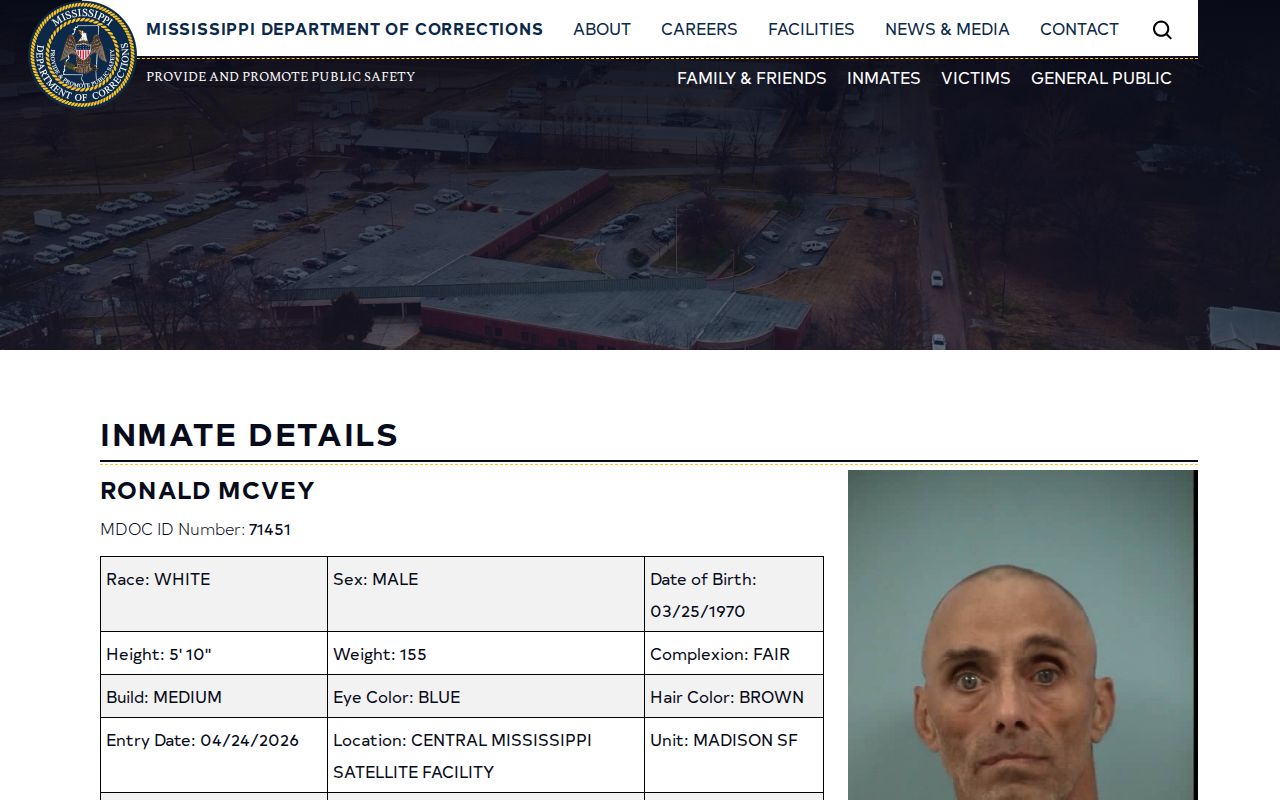
The screenshot is an interface example only. Match the actual person with several identifiers and check the live record because status and dates can change.
Mississippi DOC Tentative Release Dates
MDOC uses the term “Tentative Release Date.” Tentative means subject to review and change. The public detail does not expose the full calculation ledger. Sentence structure, custody credit, eligibility rules, earned time, disciplinary forfeiture, later court orders, detainers, parole action, and release-plan approval can alter the result. A detainer is a request or legal basis for another agency to take custody when the present custodian is finished.
The MDOC Family and Friends FAQ states that parole and ERS dates are not guaranteed. It also says a case manager verifies travel plans, gives the inmate the exact date after requirements are met, and must provide a discharge certificate before release. MDOC describes a release process that may take 30 to 45 days. That timing applies to state-prison release planning, not a routine bond release from the county side of the Bolivar regional facility.
Parole approval is also not a gate timestamp. The Parole Board makes the parole decision, but MDOC still checks the sentence, detainers, plan, and other requirements. Confirm the actual effective release through the offender record or MDOC Records. If supervision follows, the assigned Community Corrections office can confirm public status and routing within its disclosure limits.
Request Mississippi DOC Discharge Records
A discharge certificate or a written records response is stronger than a saved search screen. MDOC directs public requests through its General Public records page and the MDOC GovQA portal. Requests must be written. MDOC does not accept a public-record request by telephone. Include the legal name, MDOC number, date of birth, a narrow date range, and the precise documents sought.
Useful targets include the public offender data sheet, public movement or status entries, release authorization, release type and effective date, discharge certificate, timesheet where disclosable, and offender photograph. Ask for electronic copies and a cost estimate first. Medical material, security information, victim data, protected personal identifiers, and supervision field notes may be withheld or redacted. If MDOC withholds a field, ask for the legal basis and any reasonably separable public portion.
301 North Lamar Street
Jackson, MS 39201
601-359-5600
Regular inspection and copying hours: 8:00 a.m. to 5:00 p.m. on working days
MDOC’s published policy lists paper copies at $0.15 per page. Qualifying search, review, redaction, technology, vendor, and mailing costs may also apply. The policy provides for a written response within seven working days and generally calls for production no later than fourteen working days after the request and payment, unless justified extra time is needed.
Note: Call the switchboard for routing, but submit the actual MDOC records request in writing through the agency’s stated channel.
Bolivar’s Two Release Record Trails
The Bolivar County Correctional Facility is a regional MDOC partner under county sheriff authority. This is the county’s key records distinction. Two people at the same address can create different trails. A local detainee’s booking, bond release, court order, or transfer entry belongs with the facility, Sheriff, and court. An MDOC-sentenced prisoner has a statewide offender record and state discharge process even while housed in Cleveland.
Ask which legal authority held the person. An out-date from the county portion could mean release to the community or transfer into MDOC custody. In some cases, a sentenced person may change custody authority without immediately leaving the building. Request the release or movement reason and the receiving agency, not just the fact that a name is no longer shown.
The former Bolivar County Community Work Center or satellite is another local trap. MDOC’s closure notice and current population reporting distinguish that closed site from the operating regional facility. It should not be treated as a current place to call or a present release destination.
Verify Mississippi DOC Release Status
After an institutional release, determine whether state authority continues. Parole, ERS, probation, and post-release supervision are not the same status. The public offender or parolee search may help, while the assigned Community Corrections office can provide public routing. The Bolivar Probation & Parole Office is relevant only when that office is assigned. It cannot prove the exact time a person left an institution.
A full discharge may end the state custody trail. When the record instead shows supervision, confirm the status without seeking a residence, reporting schedule, treatment detail, victim information, or protected case-plan material. For a person convicted in Bolivar County but living or supervised elsewhere, the assigned office may be outside the county.
Three records create the soundest chain: the MDOC release or movement entry, the court judgment or Parole Board authority, and the supervision record when community oversight follows. A VINE notice can flag an event, but agency-fed alerts may lag and do not explain whether the event was discharge, parole, or transfer. Preserve the source and check date for every dynamic result.